Most producers have dozens of loops saved and almost no finished tracks. The problem isn’t talent or inspiration — it’s not knowing what comes after the loop. This article gives you a concrete system to go from a 2-bar idea to a complete track, without overcomplicating it.
1. Why loops don’t become tracks on their own
A loop is a proof of concept. It shows that an idea has potential. But finishing a track requires a different skill: arrangement. Arrangement is the art of controlling what the listener hears, when they hear it, and how much of it. Most producers avoid it because it feels less creative than making sounds — but it’s the thing that turns a sketch into music.
The single biggest mistake is trying to perfect the loop before arranging. If you spend three hours getting the kick right before you have a structure, you’re optimising something you don’t yet know how to use.
2. Know the shape before you build it
A functional electronic track has a predictable shape, and that predictability is a tool, not a limitation. Here’s a basic structure that works across most genres:
- Intro (8–16 bars): stripped version of the main elements, creates expectation
- Build (8–16 bars): elements enter gradually, tension increases
- Drop/Main (16–32 bars): full energy, all key elements present
- Breakdown (8–16 bars): space, contrast, stripped back again
- Second build (8 bars): shorter than the first, the listener knows what’s coming
- Second drop (16–32 bars): often a variation of the first
- Outro (8–16 bars): elements exit one by one
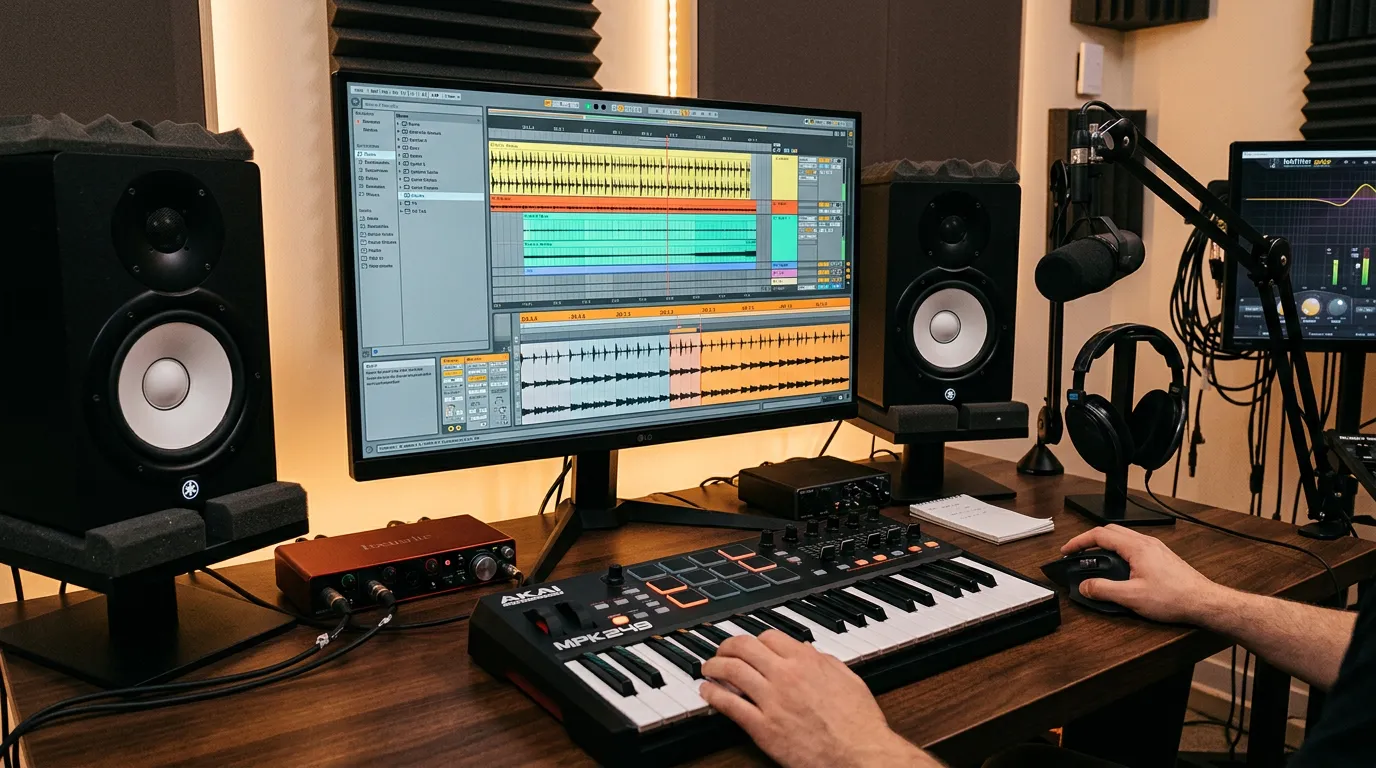
You don’t need to follow this exactly. But you need a shape. Open a new arrangement view, create empty sections with markers, and name them before you place a single note.
3. Copy first, vary later
The most efficient way to fill an arrangement is to copy your loop into every section first, then remove what doesn’t belong. This is the opposite of how most beginners work. Instead of building each section from scratch, you start with everything everywhere and subtract.
Drop your loop across the entire arrangement. Then go section by section and mute or delete the elements that shouldn’t be there yet. The intro becomes the drop minus everything except a hi-hat and a kick. The breakdown becomes the drop minus everything except a pad and a bassline. You’ve just built a draft arrangement in twenty minutes.
4. Energy is movement, not volume
A common mistake is using volume automation to create energy changes. Turning the master up isn’t an arrangement — it’s a loudness change. Real energy comes from density: how many elements are playing, how complex the rhythmic pattern is, and how much spectral space is being used.
To build energy: add elements, increase rhythmic complexity, or open a filter. To drop energy: remove elements, simplify the pattern, or close a filter. The loudness should stay roughly constant throughout the track. The density changes.
5. Transitions do the work between sections
The moment between two sections is where most tracks fall apart. Without a transition, a section change feels like a cut in a badly edited film. The simplest transition toolkit that works every time: a riser (white noise filtered up over 4 bars), a crash cymbal on the downbeat of the new section, and a bass drop (one bar of silence in the bass just before the change). These three elements alone will make any arrangement feel intentional.
6. The “good enough” decision
The reason tracks don’t get finished is perfectionism applied at the wrong stage. At the arrangement stage, good enough is the goal. A track with a complete structure and imperfect sounds is infinitely more useful than a perfect loop with no structure. You can fix sounds later. You can’t finish a track that never had a shape.
Set a time limit: two hours to have a full draft arrangement, even if it’s rough. When the two hours are up, export a rough mix. Hearing your track as a continuous piece of audio — even a bad one — changes everything about how you approach the next session.
Try it now
Take any loop you have saved. Open a new arrangement. Paste the loop across 128 bars. In the next 30 minutes, create at least five distinct sections by muting and deleting elements. Export. Listen.
Sources and further reading
- Ableton: Making Music by Dennis DeSantis — free PDF, chapters on arrangement and finishing tracks
- Sound On Sound: “Arrangement Masterclass” series
- YouTube: Underdog Electronic Music School — arrangement tutorials
Learn to produce electronic music.
Structured courses, interactive tools and real-world references. Built for producers who are just starting out.