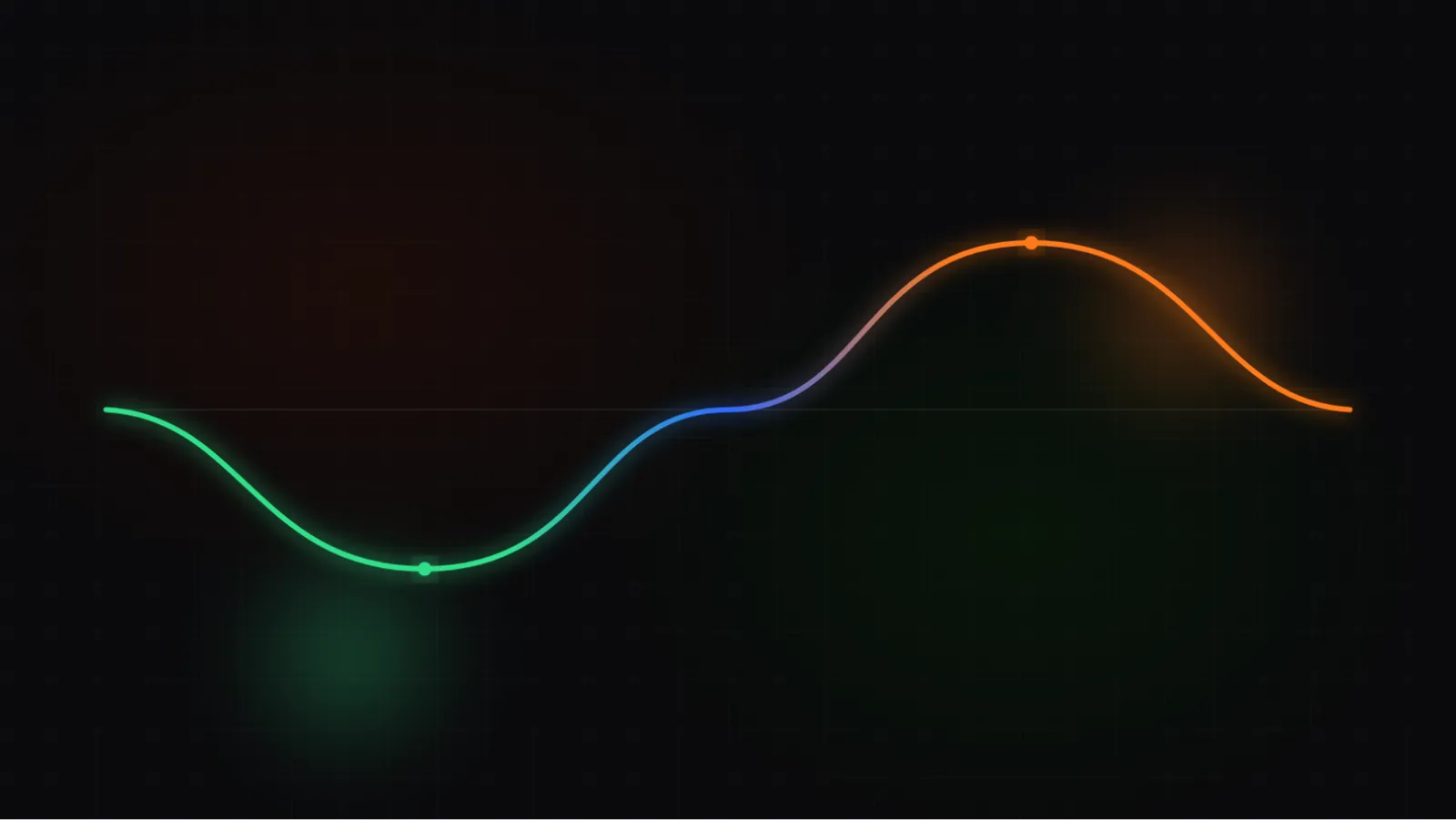
EQ is usually taught as a list: sub bass here, low mids there, presence around here, air up top. The list is accurate and mostly useless on its own, because nobody reaches for EQ because they want to adjust "low mids." They reach for it because the kick and the bass are fighting, or the vocal sounds dull, or the hi-hats are cutting through like glass. This article works backward from those problems instead of forward from a frequency chart.
Each section below names a problem you can actually hear, then explains which part of the spectrum is usually responsible. The EQ visualizer embedded further down lets you create and hear each fix directly.
Learn the spectrum by ear, not by numbers
Before fixing anything, it helps to know roughly what lives where. Sub bass, below about 60Hz, is felt more than heard, the low end of a kick or a sub bass patch. Bass, from roughly 60Hz to 250Hz, is where most of the punch and warmth of kicks, basslines and low toms live. Low mids, 250Hz to 500Hz, is the zone most responsible for a mix sounding muddy when it has too much energy. Mids, 500Hz to 2kHz, carry the body of vocals, snares and most melodic instruments. Upper mids, 2kHz to 6kHz, is where presence and clarity live, and also where harshness creeps in in when pushed too hard. Air, above roughly 8kHz, adds sparkle and openness without much perceived loudness.
None of these boundaries are exact, and every source overlaps its neighbors. The goal is not to memorize the numbers, it is to build a rough map so that when something sounds muddy or harsh, you already have a guess about where to look before you touch a single knob.
Cut before you boost
The single most underused habit in EQ is cutting instead of boosting. Boosting a frequency adds energy and often adds loudness, which can trick your ears into thinking a change sounds better simply because it is louder. Cutting removes energy that is competing with something else, which usually creates more actual clarity than any boost does.
A practical default: if a sound feels thin, resist the urge to boost highs first. Try cutting the low mids of a competing element instead. Clarity in a mix is often less about adding brightness and more about removing the mud that was hiding it.
The kick and bass problem
This is the most common frequency conflict in electronic music. Both the kick and the bass want to live in roughly the same 60Hz to 150Hz zone, and when they both get full energy there, the low end turns into an undefined rumble instead of two distinct, punchy elements.
The standard fix is complementary EQ: decide which element owns which part of the low end, then cut the other one out of that space. A common approach gives the kick a focused punch around 60 to 80Hz and a click around 2 to 4kHz for attack, while the bass gets a gentle cut in that same 60 to 80Hz pocket so it does not compete, keeping its own weight lower or higher depending on the sound. Neither element needs to disappear from the other's range entirely, but giving each one a zone where it is dominant is what makes a low end read as tight instead of muddy.
Making space for a vocal or lead
A vocal or lead that sounds dull or buried usually has nothing wrong with it in isolation. The problem is usually a low mid buildup around 250 to 500Hz coming from pads, guitars or synth layers stacked underneath it, masking the exact range where vocal warmth and clarity live.
A small, wide cut in that 250 to 500Hz range on the supporting elements, rather than a boost on the vocal itself, is often the fastest way to make a vocal or lead cut through without sounding artificially bright. Boosting the vocal to compensate for a crowded mix usually just makes everything louder together, not clearer.
Taming harshness and excess brightness
Harshness usually sits in the upper mids, roughly 2 to 5kHz, the same range responsible for presence when used well. Pushed too far, that same range turns aggressive, tiring to listen to at volume, and fatiguing over a full track. Hi-hats, cymbals and bright synth leads are the usual sources.
A narrow cut in the specific frequency where the harshness lives, found by sweeping a boosted band until the offending frequency jumps out, then pulling it down instead of boosting it, is the standard technique here. It is more surgical than a broad high cut, which tends to dull the whole sound instead of removing just the offending sliver.
Recreate all three fixes from this article in the visualizer above. First, cut around 250 to 400Hz to hear how low mid removal changes clarity. Then set up a narrow cut around 3kHz and sweep it back and forth to hear how a small frequency range can sound harsh in isolation even when it barely changes the overall tone. Finally, try a gentle cut on one band around 70Hz and notice how much punch you can remove without the sound feeling thin.
EQ solves problems, not taste
Every example above is a subtractive fix, removing something that is getting in the way of something else. Boosting has its place too, mostly for adding character rather than fixing conflicts, but it is worth building the habit of reaching for a cut first. A mix with every element gently making room for its neighbors, rather than every element fighting to be loudest, is what actually reads as professional, regardless of genre.
If you are still deciding what to build a sound out of in the first place, our article on how synthesizers work and the follow-up on ADSR envelopes cover the earlier steps in that chain.
Electronic Music Production for Beginners
Mixing fundamentals like this one, taught in sequence, with hands-on assignments and the full library of interactive tools.
Learn to produce electronic music.
Structured courses, interactive tools and real-world references. Built for producers who are just starting out.